2026 Intersessional Meetings

Stream IM26 Day Four Morning

Stream IM Day 3 Afternoon

Stream IM Day 3 Morning

Stream IM Day 2 Afternoon

Stream IM26 Day 2 Morning

Stream Day 1 - Afternoon

Stream Day 1 Morning

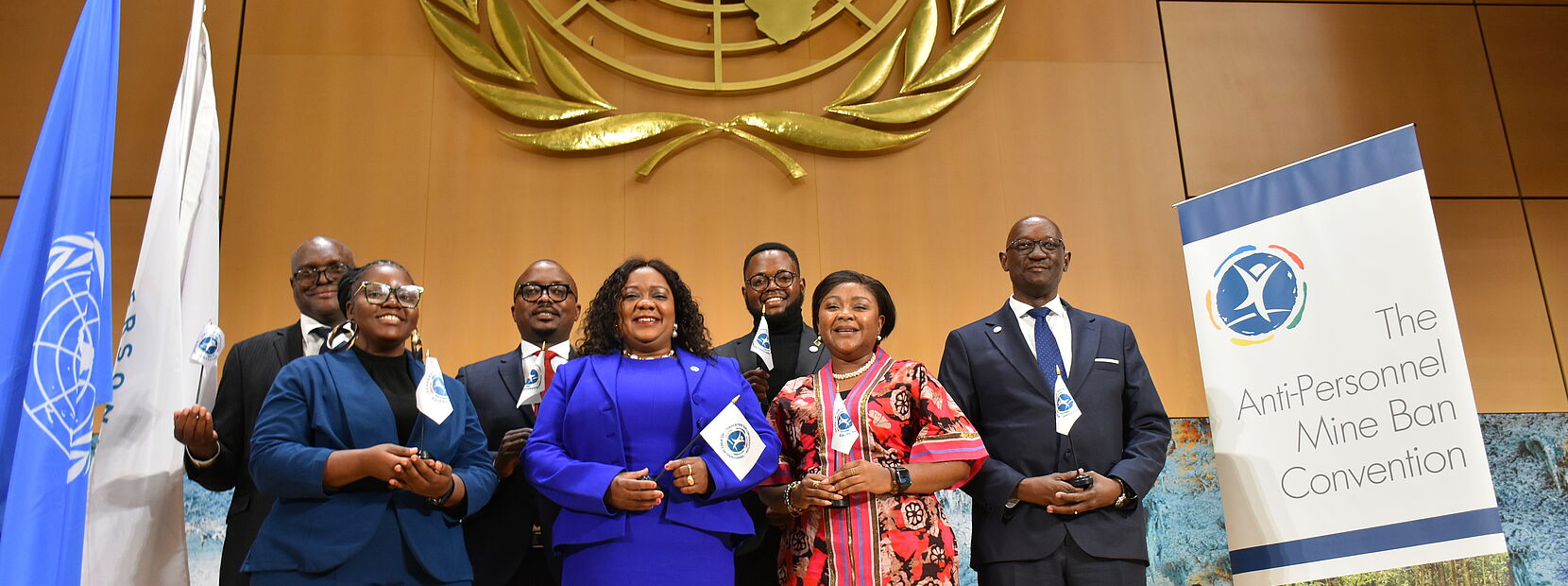
The 2026 Intersessional Meetings took place on 15-18 June 2026 at the Centre International de Conférences Genève (CICG).

The Meetings were chaired by H.E. Ms LUAMBIA Eunice M. Tembo, Ambassador and Permanent Representative of Zambia to the United Nations in Geneva and President of the Twenty-Third Meeting of the States Parties (23MSP). The Intersessional Meetings are held annually thanks to support provided by Switzerland.

Summary

H.E. Eunice M. Tembo Luambia, Ambassador and Permanent Representative of Zambia to the United Nations in Geneva, President of the Twenty-Third Meeting of the States Parties (23MSP), H.E. Julien Thöni, Permanent Representative of Switzerland to the Conference on Disarmament, H.E. Tobias Privitelli, Director of the Geneva International Centre for Humanitarian Demining, and Mr Mirsad Tokic delivered opening remarks.

In recent years, several global frameworks and initiatives have been launched to strengthen implementation of International Humanitarian Law (IHL). While the Convention’s norms enjoy broad adherence, including by many States not party, withdrawals from the Convention and the continued and increased use of anti-personnel mines and their severe humanitarian consequences remain a grave concern. The Siem Reap–Angkor Action Plan 2025–2029 (SRAAP) reaffirms that States Parties remain committed to the Convention’s principles, purpose, and objectives and underscores the urgency of strengthening collective and coordinated efforts to universalize the Convention and reinforce its norms. 

In particular, the SRAAP places renewed emphasis on:

  • Promoting ratification or accession by States not party;

  • Promoting universal observance of the Convention’s norms and objectives;

  • Condemning violations of these norms and taking appropriate steps to end the use, stockpiling, production, and transfer of anti-personnel mines by any actor, including armed non-state actors.

The panel discussed global initiatives to strengthen IHL and the place of the Anti-Personnel Mine Ban Convention in these initiatives. The discussion was moderated by H.E. Eunice M. Tembo Luambia, Permanent Representative of Zambia to the United Nations and President of the Twenty-Third Meeting of the States Parties (23MSP).

The panel featured the following presentations: 

  • H.E. Caroline Ziadeh, Ambassador and Permanent Representative of Lebanon to the United Nations in Geneva
  • Carolyne Mélanie Régimbal, Chief of Service, United Nations Office for Disarmament Affairs’ Geneva Office
  • Kareen Jabre, Director, Division of Programmes at the Inter-Parliamentary Union
  • Laurent Gisel, Head of the Arms and Conduct of Hostilities Unit, International Committee of the Red Cross
  • Tamar Gabelnick, Director, International Campaign to Ban Landmines-Cluster Munition Coalitions
  • H.E. Alexander Kmentt, Ambassador and Permanent Representative of Austria to the United Nations in Geneva

The following delegations shared views during the panel discussion: 

  • Cambodia
  • Peru
  • Belarus
  • France
  • Indonesia
  • Switzerland
  • GICHD
  • ICBL
  • Zambia
  • Mauritania

The panellists delivered closing remarks.

Following the panel discussion, the President provided an overview of her activities in relation to implementation of the universalization commitments of the SRAAP (Actions 11 to 12). 

Delegations were invited to provide updates on matters related to universalization of the Convention and its norms and implementation of Actions 11 and 12 of the SRAAP. 

The following States not party provided updates on efforts made to accede to the Convention or on steps taken to move closer to the Convention:

  • Republic of Korea

  • Azerbaijan

  • Myanmar

  • Lao PDR

The following other delegations shared views on matters related to universalization: 

  • Peru

  • Sierra Leone on behalf of the African Group

  • South Africa

  • European Union

  • Ireland

  • Germany

  • Belgium

  • Thailand

  • Algeria

  • Chile

  • Colombia

  • Austria

  • Mexico

  • Brazil

  • Bangladesh

  • Palau

  • Mali

  • Cameroon

  • Tajikistan

  • Panama

  • United Kingdom

  • Canada

  • Armenia (right of reply)

  • NPA

  • Spain

  • UNODA on behalf of UN-Inter-Agency Coordination Group on Mine Action

Cooperation and assistance remain a cornerstone of the Anti-Personnel Mine Ban Convention and a critical enabler for achieving the ambitions of the Siem Reap–Angkor Action Plan 2025–2029 (SRAAP). As affected States Parties work to meet their survey, clearance, risk education, victim assistance, and capacity-strengthening commitments, sustained and well‑coordinated support from donor States and partners is essential. In this regard, both affected and donor States have a shared responsibility to ensure that cooperation and assistance thrive and drive implementation forward.

In particular, the SRAAP places renewed emphasis on:

  • Strengthening national ownership;

  • Enhancing transparency and dialogue between affected and donor States;

  • Coordinating support for implementation;

  • Promoting predictable, needs‑driven, evidence‑based assistance;

  • Sharing good practices and lessons learned to accelerate progress.

The panel explored how the SRAAP commitments can be fully realised, what progress has been achieved, what challenges remain, and highlighted the added value of establishing national mine action platforms. The panel discussion was moderated by Mr Paul Serge Ntamack Epoh, First Counsellor at the Permanent Mission of Cameroon to the United Nations and Chair of the Committee on the Enhancement of Cooperation and Assistance 

The panel featured the following presentations: 

  • H.E. Tomiko Ichikawa, Ambassador and Permanent Representative of Japan to the Conference on Disarmament

  • Tarik Šerak, Head of Mine Action Management Department, Bosnia and Herzegovina Mine Action Centre

  • Col. Charbel Njeim, Operations Section Head, Lebanon Mine Action Centre 

  • H.E. David Riley, Ambassador and Permanent Representative of the United Kingdom to the Conference on Disarmament

  • Steinar Essen, Global Mine Action Advisor, Crisis Bureau, UNDP

The following delegations shared views during the panel discussion: 

  • Indonesia

  • UNMAS on behalf of UN-IACG

  • GICHD

Following the panel discussion, the Chair of the Committee on the Enhancement of Cooperation and Assistance, Cameroon, presented the activities undertaken by the Committee to implement its mandate as well as the Committee’s observations on States Parties’ implementation of their cooperation and assistance commitments under Actions 41 to 45 of the SRAAP. 

Slovenia, as the Committee’s gender focal point, delivered remarks on gender and diversity in cooperation and assistance efforts.

States Parties implementing key provisions of the Convention provided information on cooperation and assistance, including on their challenges and requirements for assistance: 

  • Thailand
  • Mali
  • State of Palestine
  • Sudan
  • Tajikistan  
  • Zimbabwe
  • Cameroon
  • Peru
  • Zambia
  • Mauritania
  • DRC

In addition, the following delegation submitted a written statement: 

  • Cambodia

States Parties in a position to provide assistance provided information on their cooperation and assistance efforts under Article 6 of the Convention: 

  • European Union
  • Ireland
  • Belgium
  • Denmark
  • Germany
  • Slovenia
  • Australia
  • Italy
  • France
  • Indonesia
  • Spain

The following other delegations shared views on matters related to cooperation and assistance: 

  • MAG
  • Oman
  • NPA
  • ICBL-Landmine Monitor
  • GICHD

The Chair of the Committee on the Enhancement of Cooperation and Assistance, Cameroon, delivered concluding remarks. 

The Chair of the Committee on Article 5 Implementation, Algeria, presented an update on the progress and status of the Article 5 extension request process. The following States Parties which have submitted or will submit requests for extension of their Article 5 deadlines for consideration at the 23MSP, presented highlights of their requests:

  • Bosnia and Herzegovina

  • Mali

  • Mauritania

  • Senegal

  • Serbia 

  • Somalia 

  • Sudan

  • Tajikistan

  • Thailand

The presentations from these States Parties were followed by comments from the following delegations:

  • On the request submitted by Bosnia and Herzegovina: Mine Action Review and the ICBL.

  • On the request submitted by Mali: joint statement by ICBL and Mine Action Review.

  • On the request submitted by Mauritania: Mine Action Review and the ICBL.

  • On the request submitted by Senegal: Mine Action Review and the ICBL.

  • On the request submitted by Serbia:  ICBL and Mine Action Review. 

  • On the request submitted by Somalia: Mine Action Review and the ICBL.

  • On the request submitted by Sudan: Mine Action Review, ICBL, Yemen, International Humanitarian Law & Youth Initiative.

  • On the request submitted by Tajikistan: Mine Action Review and the ICBL.

  • On the request submitted by Thailand: Mine Action Review, ICBL, Cambodia (right of reply) and Thailand (right of reply).

The following delegations shared views of a general nature on the implementation of Article 5 or on the extension request process:  

  • Nicaragua

  • Cameroon

  • Indonesia

The following States Parties which were requested to submit updated work plans in accordance with decisions on their extension requests presented an overview of their updated work plans:

  • Türkiye

  • Yemen


Ensuring that mine victims can access their rights on an equal basis with others remains a core commitment of the Anti‑Personnel Mine Ban Convention. The Siem Reap–Angkor Action Plan 2025-2029 (SRAAP) underscores that, to ensure sustainability, victim assistance must be fully integrated into national policies, plans, budgets, and legal frameworks related to disability rights, rehabilitation, health, mental health, education, employment, development, and poverty reduction. 

The SRAAP places renewed emphasis on, amongst other:

  • Ensuring that a relevant government entity in affected States Parties is assigned as focal point to a) coordinate victim assistance; b) oversee and enhance the integration of victim assistance into broader national policies, plans, budgets, and legal frameworks; and c) work with relevant national entities, survivors, and their representative organisations to develop an inclusive national timebound disability action plan; 

  • Integration of victim assistance with national mechanisms established for the implementation of the Convention on the Rights of Persons with Disabilities; and

  • Carrying out inter-ministerial and multi-sectoral efforts to ensure that the needs and rights of victims of mines and other explosive ordnance are effectively addressed through relevant national policy and legal frameworks and budgets.

While many States Parties have made significant progress in embedding victim assistance into broader national frameworks, challenges remain. 

The panel explored how these commitments can be fully realised, what progress has been achieved, and how to address remaining challenges. The panel was moderated by Ms Julia Eberl, Counsellor at the Permanent Mission of Austria to the United Nations and Chair of the Committee on Victim Assistance. 

The panel featured the following presentations: 

  • Nelson Romero, Administration Manager, Veterans and Ex-Combatants Benefits Administration Institute (INABVE), El Salvador

  • Rejoice Mubhika, Disability Specialist, Disability Affairs Department, Ministry of Public Service, Labour and Social Welfare, Zimbabwe

  • Suela Lala, Director, Together Foundation, Albania

  • Elke Hottentot, Senior Advisor, Inclusion Policy & Strategy, Humanity & Inclusion 

The following delegations shared views during the panel discussion: 

  • Peru

  • GICHD

  • ICBL

Following the panel discussion, the Chair of the Committee on Victim Assistance presented the Committee’s key observations on the States Parties’ implementation of their victim assistance commitments under Actions 30 to 39 of the SRAAP. 

Sri Lanka, as the Committee’s gender focal point, delivered remarks on gender equality in victim assistance.

The following States Parties implementing victim assistance commitments offered updates on their efforts and challenges faced in the implementation of their commitments:

  • Angola 

  • Cambodia

  • El Salvador

  • South Sudan

  • Sri Lanka

  • Peru

  • Burundi 

  • State of Palestine 

  • Zambia

  • Sudan 

  • Tajikistan 

  • Yemen 

  • Zimbabwe

  • Algeria 

  • Colombia

  • Guinea Bissau

  • Thailand

  • Senegal

The following other delegations shared views and information on matters related to victim assistance:

  • European Union

  • Austria 

  • Italy

  • Japan

  • Philippines

  • Norway

  • South Africa 

  • Indonesia

  • Cameroon

  • ICBL

  • IHL & Youth Initiative

  • GICHD

  • UNMAS

The Chair of the Committee on Victim Assistance, Austria, delivered concluding remarks.

The Siem Reap–Angkor Action Plan 2025–2029 (SRAAP) highlights a core best practice: ensuring the establishment of sustainable national capacities able to coordinate, regulate, and manage the national mine action programme including survey, clearance, mine risk education, and victim assistance and undertake post completion activities in the event that previously unknown mined areas including newly mined areas are discovered. Action 21 of the SRAAP reinforces this imperative, calling for resilient national systems that can maintain mine action oversight and react effectively to any post‑completion discoveries. This commitment draws from the guidance adopted at the Twelfth Meeting of States Parties in a document presented by the Committee on Article 5 Implementation entitled Proposed rational response to States Parties discovering previously unknown mined areas after deadlines have passed.

As more States Parties approach completion, the need for nationally anchored, context‑specific capacities for survey, clearance, and long‑term mine risk education becomes even more pressing. Lessons from States Parties in the process of implementing Article 5 and those that have completed their obligations offer valuable models for designing institutional frameworks that can manage residual contamination.

The panel explored how States Parties currently in the process of implementing Article 5 and those that have completed implementation are addressing/planning to address residual contamination following implementation of their Article 5 obligations. The panel discussion was moderated by Ms Serine Zidouri, Attaché at the Permanent Mission of Algeria to the United Nations and Chair of the Committee on Article 5 Implementation. 

The panel featured the following presentations: 

  • Dejan Rendulić, Croatian Mine Action Centre, Civil Protection Directorate, Ministry of the Interior, Croatia

  • Coronel Omar Joaquin Montenegro, Chief, Army Corps of Engineers, Nicaragua 

  • Wend Benedo Jean Sylvestre Korogo, Permanent Secretary, National Commission for the Control of Weapons (CNCA),  Burkina Faso

The following delegations shared views during the panel discussion: 

  • Tajikistan

  • UNMAS on behalf of UN-IACG

  • IHL & Youth Initiative

Following the panel discussion, the Chair of the Committee on Article 5 Implementation, Algeria, presented the Committee’s observations on implementation by States Parties of their mine clearance and mine risk education and reduction commitments under Actions 17 to 29 of the SRAAP. 

Norway, as the Committee’s gender focal point, delivered remarks on gender and diversity in the context of the Committee’s work.

Bulgaria, as the Committee’s mine risk education focal point, delivered remarks on the importance of mine risk education and reduction efforts by States Parties in many contexts including after States’ completion of their Article 5 obligations.  

The following States Parties implementing Article 5 presented updates on progress in meeting their deadlines and on their efforts to establish sustainable national capacities to ensure implementation of Article 5: 

  • Democratic Republic of the Congo
  • Sri Lanka
  • Cambodia
  • Guinea Bissau
  • Yemen
  • Angola
  • Zimbabwe
  • South Sudan
  • Peru
  • Ethiopia
  • Thailand

The following other delegations shared views on matters related to Article 5 implementation:

  • European Union
  • MAG
  • ICBL

The following delegation submitted a written statement: South Africa. 

The Chair of the Committee on Article 5 Implementation, Algeria, delivered final remarks.

Action 44 of the Siem Reap-Angkor Action Plan 2025-2029 (SRAAP) calls on States Parties to explore the feasibility of establishing a Voluntary Trust Fund (VTF) to support affected States Parties struggling to secure international assistance for their legal and time-bound commitments under Article 5 of the Convention, with a view to reporting on the progress made to the Twenty-Second Meeting of the States Parties (22MSP) and to taking a decision thereon by no later than the Twenty-Third Meeting of the States Parties (23MSP).

At the 22MSP, the Working Group established to explore the feasibility of establishing a VTF presented a report on their efforts to develop a feasibility study. Since the 22MSP the working group has continued to explore the feasibility of establishing a VTF. 

Norway, in its capacity as Chair of the Working Group, presented the Working Group’s progress, findings and suggestions going forward towards the 23MSP. 

The following delegations shared views or comments related to the establishment of a VTF: 

  • Belgium
  • Guinea Bissau
  • Chile
  • Thailand
  • Austria
  • Niger
  • Peru
  • France
  • United Kingdom
  • Türkiye
  • Mauritania
  • Mexico, on behalf of a group of States
  • Brazil
  • Ireland
  • Colombia
  • Germany
  • Yemen
  • Zambia
  • Mine Action Review
  • UNMAS
  • NPA
  • ICBL
  • MAG

The Chair of the Committee on Cooperative Compliance, Zambia, presented the Committee’s preliminary observations on implementation by States Parties of their compliance commitments under Actions 46 to 48 of the SRAAP. 

The following States Parties with alleged or known non-compliance with the general obligations under Article 1 provided an update on their efforts to address these matters: 

  • Thailand

  • Sudan

  • Yemen

  • Cambodia

The following other delegations took the floor to share views on matters related to cooperative compliance: 

  • ICBL

  • NPA

Cambodia and Thailand exercised their right of reply. 

The Chair of the Committee on Cooperative Compliance provided an update on the status of Article 7 reporting, underlining the importance of the submission of detailed information by States Parties with outstanding obligations. 

No delegation took the floor on Article 7 implementation.

The Chair of the Committee on Cooperative Compliance delivered an update on the status of implementation of Article 9 indicating that progress in this area had been slow and highlighting that awareness still needed to be raised on the importance of adopting national legislation to prevent and suppress activities prohibited under this Convention, in line with Article 9.

No delegation took the floor to provide updates on matters related to Article 9 implementation. 

The Chair of the Committee on Cooperative Compliance delivered final remarks. 

The President presented an overview of the key commitments of the Siem Reap-Angkor Action Plan related to stockpile destruction and retained mines (Actions 13 to 16) and presented her activities in this regard.  

The following State Party that has missed its Article 4 deadline provided an update on the implementation of its stockpile destruction commitments in accordance with the SRAAP (Action 14): 

  • Greece

The following delegation shared views on matters of stockpile destruction: 

  • ICBL

The President provided an update on the status of implementation of Article 3 and presented her activities in this regard. She underlined the importance of the annual submission of information on anti-personnel mines retained for permitted purposes and on the exploration of alternatives to live anti-personnel mines, in line with the commitments contained in the Siem Reap-Angkor Action Plan. 

To help raise awareness of the available alternatives, their benefits and practical use, Mr Ole Feurer, Head of Humanitarian Action at the Swiss EOD Centre, delivered a presentation on alternatives to anti-personnel mines retained for research and training. 

The following delegations shared views on matters related to retained anti-personnel mines: 

  • ICBL
  • Indonesia
  • Nicaragua

10. Preparations for the Twenty-Third Meeting of the States Parties (23MSP)

The President of the Twenty-Third Meeting of the States Parties (22MSP) presented a draft agenda and programme of work for the 23MSP and provided an update on preparations for the 23MSP. 

  • 23MSP draft provisional agenda

  • 23MSP draft provisional programme of work

UNODA provided an update on financial and organisational matters related to the 23MSP:

  • UNODA

Australia, in its capacity as Coordinator of the Sponsorship Programme, provided an update on the Sponsorship Programme.

  • Australia, as Coordinator of the Sponsorship Programme

The President recalled the election by the 22MSP of Ambassador Christophe Payot, Permanent Representative of Belgium to the United Nations in Geneva, as the President of the Twenty- Fourth Meeting of the States Parties. 

The President also recalled the decision of the 22MSP to hold the Twenty-Fourth Meeting of the States Parties (24MSP) at the end of November – beginning of December 2027 subject to the availability of conference space and proposed that the 24MSP be held on 29 November to 3 December 2027 at the Palais des Nations in Geneva. 

The President further proposed that the next Intersessional Meetings be held on 21-24 June 2027. 

The President informed that, on 25 February 2026, following her letter to solicit expressions of interest from States Parties wishing to fill the Committees positions, more expressions of interest than existing Committee positions were received. The President indicated that she will be working to develop a balanced proposal for presentation at the 23MSP informal meeting in September. 

The President presented an update on the outcomes of the 2026 Pledging Conference.

The President encouraged States Parties to make contributions to the ISU as soon as possible so that sufficient funding is received for the unit’s work and the support to States Parties can continue uninterrupted.  

The ISU Director provided an update on the ISU’s activities and finances.

No delegation took the floor on these matters. 

H.E. Eunice M. Tembo Luambia, Ambassador and Permanent Representative of Zambia to the United Nations in Geneva, President of the Twenty-Third Meeting of the States Parties delivered closing remarks.